AI Executive Assistant
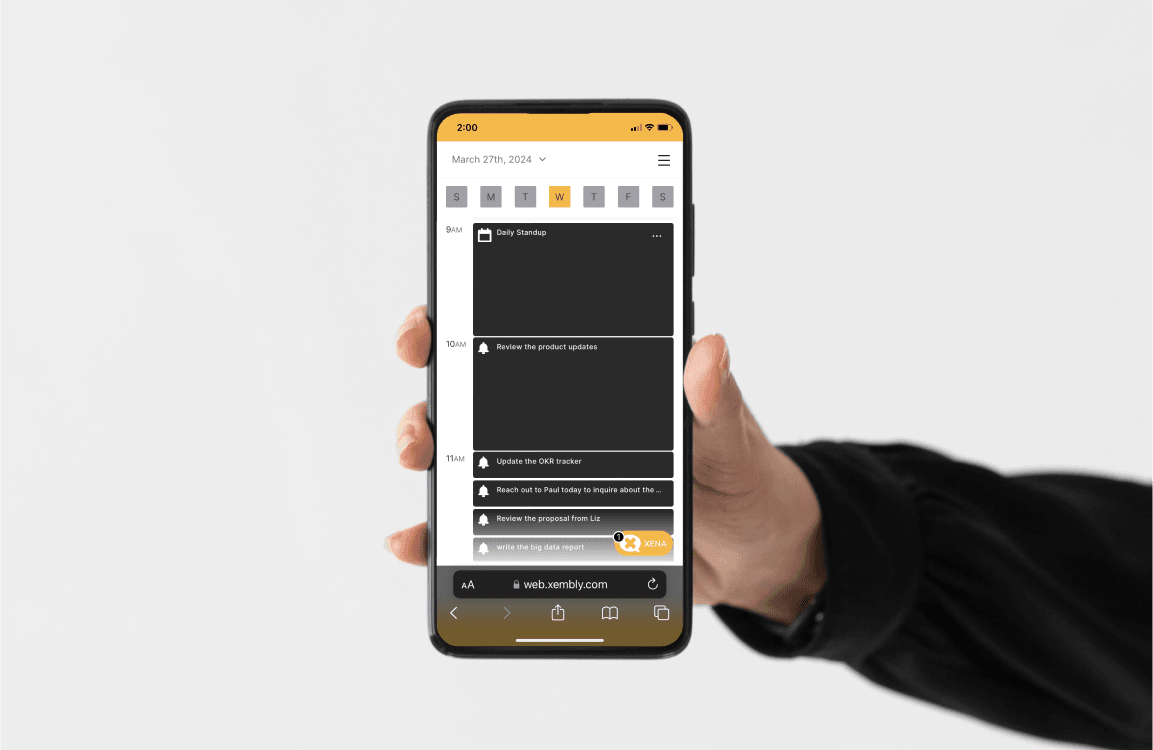
We built the product surfaces for an AI executive assistant trusted by Docker, Yahoo, and Qualtrics. Xembly's AI assistant attended meetings, wrote the summaries, assigned the follow-ups, and untangled everyone's calendars. Nullwest built the products people actually touched — the web app, mobile experience, Slack integration, and Chrome extension — and wired them to the AI underneath
About Xembly
Xembly set out to give every professional what only executives used to have: a real assistant. Backed by $20M from Lightspeed and Norwest, the Seattle-based company built Xena, an AI executive assistant that joined meetings, produced accurate notes with its VoicePrint technology, turned conversations into assigned action items, and handled the scheduling back-and-forth that eats entire afternoons.
Enterprise teams at Docker, Yahoo, and Qualtrics relied on it daily — which meant the product had to work, every time, inside the tools their people already lived in.
What we did
Before Nullwest existed, there was Xembly. Nullwest's founders were full-time members of Xembly's early engineering team — Scott as Founding Engineer and front-end tech lead, responsible for quality across every client-facing product the company shipped.
Working shoulder-to-shoulder with the Xembly team, we collaborated on every major piece of the product — and often built the majority of it ourselves:
- The flagship web application, responsive across desktop and mobile - The in-product chat experience for Xena, the AI assistant - Task management and calendar interfaces - The Slack app that brought scheduling and summaries into the channel where work happens - A Chrome extension embedding Xembly directly into Google Calendar - Recommendation algorithms, database architecture, and the AI pipelines connecting it all
That range — from pixel-level UI to production AI systems — is the experience Nullwest was founded on. We don't just advise on products like this. We've shipped one.
The hard parts (and how we handled them)
Adoption can't wait for users to change their habits New software fails when it asks people to work differently, so Xembly had to live inside Google Calendar, Slack, and Zoom from day one. We built a shared JavaScript codebase that powered the web app, Slack interface, and Chrome extension alike — one investment, three surfaces, faster shipping. A robust automated test suite and live monitoring with Sentry meant we could release new features weekly without breaking what customers already depended on.
You do not get a second chance with someone's calendar A missed meeting or a leaked calendar is a lost customer. We held client calendar data to strict security standards and built a system of synthetic test personas — realistic but fully abstracted from real customer data — so new scheduling algorithms could be battle-tested without ever putting an actual user's calendar at risk.
The bar is set by the best software your users already own Xembly's customers spent all day in polished tools like Slack and Google Workspace, and anything slower or clunkier would get abandoned. Building on Next.js and Tailwind, and iterating in tight cycles with the product team, we shipped an interface fast and refined enough to sit alongside the tools professionals trust most.
The outcome
A full product suite — web, mobile, Slack, and Chrome extension — shipped and maintained in production. Enterprise customers including Docker, Yahoo, and Qualtrics using it daily. An architecture that let a small startup team ship like a much larger one.
Building an AI product — or adding AI to one you already have? The team that helped build Xembly from the inside is now Nullwest. Let's talk about yours.
 NextJs
 Tailwind
 NodeJS
 Jest
Jest OpenAI API
 Google API
 Slack API
 Python
 Kubernetes
 PostGRES